AI Answer Engine Visibility: Why Brand Monitoring Now Includes Chatbots
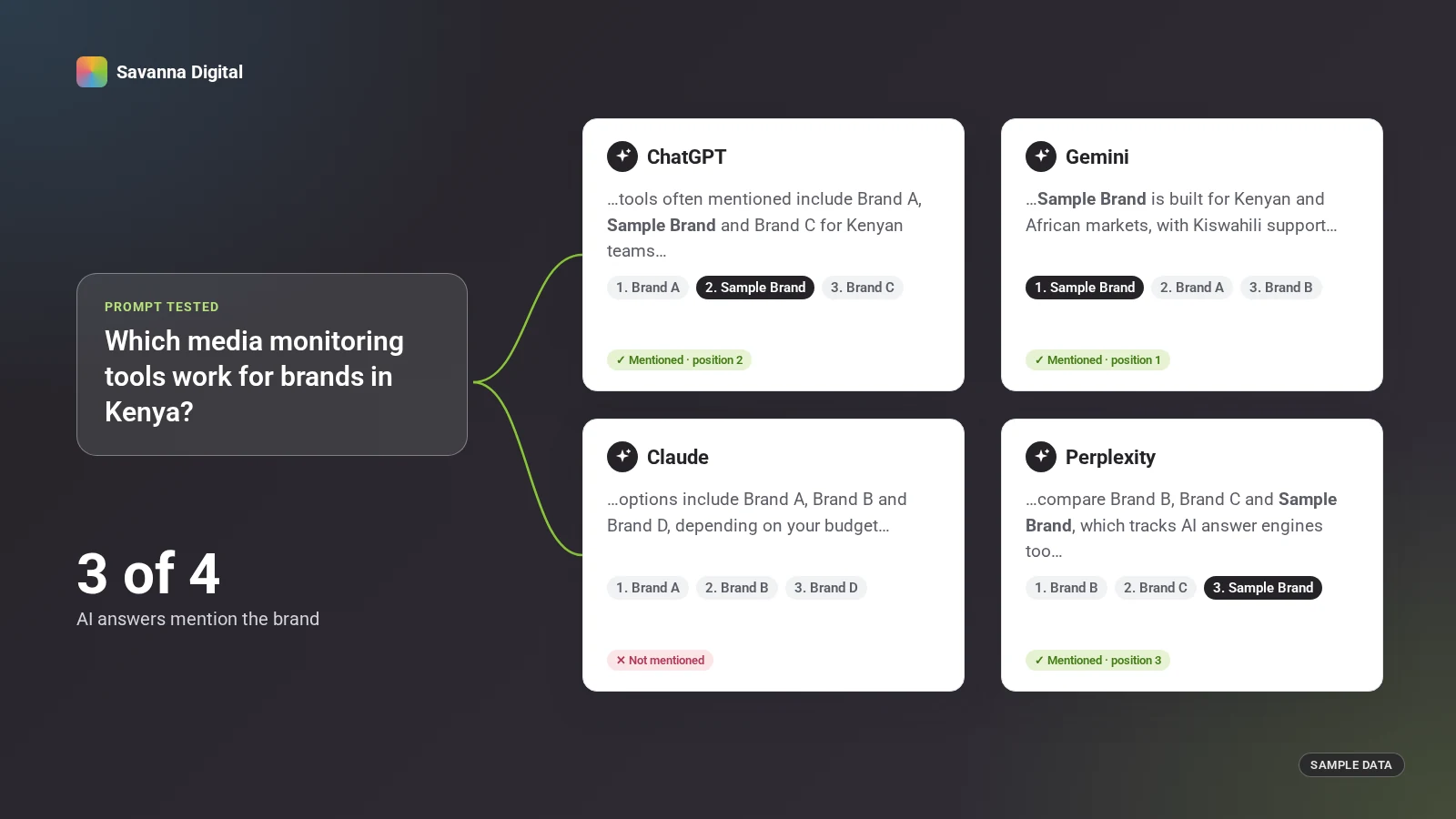
For years, "how do people find out about my brand online" mostly meant one question: how do you rank on a search engine results page. That's no longer the whole picture. A growing share of people now ask an AI chatbot directly — ChatGPT, Gemini, Claude, Perplexity — instead of, or in addition to, typing a query into a traditional search box. When someone asks one of these tools to recommend a product, compare options in a category, or explain what a company does, the chatbot doesn't hand back a list of links. It synthesizes an answer, and that answer is where your brand either shows up accurately, shows up poorly, or doesn't show up at all.
Traditional media monitoring tracks what's said about your brand across news, social media, blogs, and forums. AI answer-engine visibility is the natural extension of that same idea: tracking what's said about your brand when an AI model is asked about your category, and how accurately and favorably it represents you relative to competitors. It's a monitoring problem because, just like a negative news story or a wave of critical social posts, an AI-generated answer that misrepresents your product, cites outdated information, or simply omits you in favor of competitors is a reputation event — it's just happening in a new channel that most brands aren't yet watching.
The mechanics are also different enough from search that it's worth treating as its own thing rather than folding it into "SEO" and moving on. A search ranking is a position on a page you can screenshot. An AI-generated answer is synthesized fresh each time, pulling from whatever sources the model was trained on or retrieves at query time, and it can vary between models, between prompts, and over time as models are updated. That makes it harder to track by hand and easier to miss entirely if nobody on the team is specifically looking.
AI models build their answers from the same public information ecosystem that social listening tools already track: news coverage, review sites, official company pages, forums, and social conversation. That's the practical link between the two disciplines. A brand with a thin, outdated, or inconsistent public footprint gives an AI model less accurate material to draw from, and a confused or negative pattern in how a brand is discussed publicly can end up reflected in how a chatbot summarizes that brand too. Keeping your public-facing information accurate and current, and staying aware of how your brand is actually discussed in the sources these tools draw from, is the most direct lever a team has.
Three things matter most when a brand starts paying attention to this channel: whether the brand is mentioned at all when a relevant category question is asked, whether the description is accurate compared to what the brand actually offers, and how it's positioned relative to named competitors. None of this requires guessing — it requires periodically asking the same category questions a prospective customer might ask, across the major AI assistants, and tracking how the answers change over time. That's the same discipline as tracking share of voice in traditional media, applied to a new surface.
This is also why Savanna Digital built AI Answer-Engine Visibility (LLM Listening) into its product suite: seeing how a brand shows up when people ask ChatGPT, Gemini, Claude, or Perplexity questions related to its category, as a companion to the news, social, and forum monitoring that already forms the core of the platform. It's currently included as part of the Enterprise plan, alongside bring-your-own-content analysis, for teams that want a fuller picture across every channel where their brand's reputation is actually being formed.
AI answer engines aren't replacing traditional search or traditional media monitoring — they're adding a channel on top of both. Brands that already take social listening seriously are well positioned to extend that same discipline here: keep the public information ecosystem accurate, watch how the conversation is actually framed, and treat an AI-generated misrepresentation with the same seriousness as a news story that gets the facts wrong.
See how Savanna Digital tracks brand visibility across AI answer engines.
Explore AI Answer-Engine VisibilityWant us to do this for you? See our content and on-page SEO services.
Start tracking your brand's presence across the web and AI in minutes.
Start free — no credit card required.