Real-Time Alerts vs. Traditional Media Monitoring: What's the Difference?
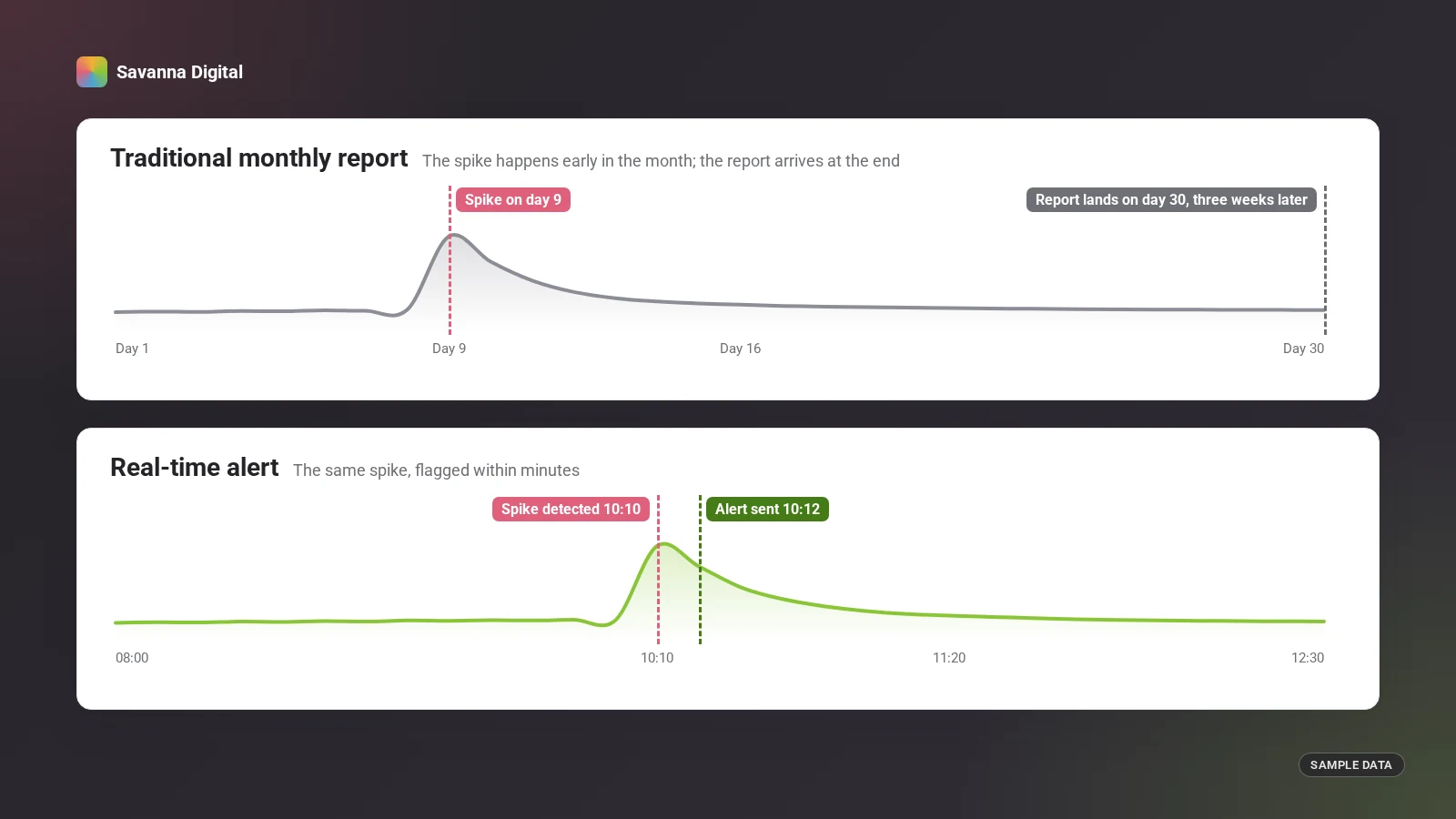
"We monitor our brand online" can mean very different things depending on who's saying it. For a lot of teams, it still means someone checking a dashboard or running a search once a day, or reviewing a digest email every morning. That's monitoring, technically. It's just monitoring on a delay — and the size of that delay is exactly what separates it from real-time alerting.
Traditional media monitoring, in most teams' actual day-to-day practice, is periodic rather than continuous: someone logs into a tool or runs a set of searches on a schedule, skims what's new, and flags anything that looks important. It works reasonably well for tracking general sentiment trends or building a weekly report. Where it struggles is speed. If something starts spreading between one check and the next, the team finds out whenever the next check happens to fall — which could be hours, or until the next morning.
Real-time alerts remove the schedule from the equation. Instead of a person deciding when to look, the system watches mention volume and sentiment continuously and notifies the team the moment either shifts outside the normal range for that brand or keyword. Alerts go to email, Slack, or a dashboard, so whoever's on point sees it as it's detected rather than at the next scheduled check-in. The underlying data is the same kind of mention tracking and sentiment scoring that powers day-to-day monitoring — alerting is a layer on top of it, built to flag the moments that shouldn't wait.
The difference between periodic and real-time monitoring is mostly invisible on a normal day, when conversation volume is steady and nothing unusual is happening. It becomes very visible the moment something does happen. For a PR team, that's the difference between catching a story while it's a handful of posts and finding out once it's already the day's news. For a customer care team, it's the difference between responding to a single complaint and responding to a complaint that's had all day to turn into a pile-on. In both cases, the story or the complaint doesn't wait for the next scheduled review, so a monitoring setup that only checks in periodically is structurally a step behind.
It's worth being clear about what "outside the normal range" means here, since it's the whole basis for an alert firing at all. A brand's mention volume and sentiment naturally move around from day to day — a launch, a piece of press, an ordinary news cycle. An anomaly is a shift that stands out from that everyday pattern, not just any change at all. That's what separates a useful alert from noise: it's tuned to flag the moments that are actually unusual for a given brand or keyword, rather than firing on every single mention.
Alerts aren't a substitute for the underlying monitoring and sentiment analysis — they're built on top of it. An alert tells a team that something changed; the monitoring and sentiment feed is where the team goes to understand what that something actually is, who's saying it, and how it's being framed. The two are meant to work together: alerts catch the moment something needs attention, and the feed underneath gives the context needed to respond to it properly.
Savanna Digital's real-time alerts and anomaly detection notify a team the moment mention volume or sentiment shifts outside the normal range, before a small issue becomes a full crisis, sent to email, Slack, or the dashboard. It sits directly on top of the same monitoring and sentiment analysis that tracks a brand's mentions across news, social, blogs, and forums in the first place, so an alert always comes with the underlying conversation attached, not just a notification with no context behind it.
See how Savanna Digital's real-time alerts work in practice.
Explore Real-Time AlertsWant us to do this for you? See our SEO services.
Start tracking your brand's presence across the web and AI in minutes.
Start free — no credit card required.