Competitor Benchmarking: How to Track Rival Brands Across African Media
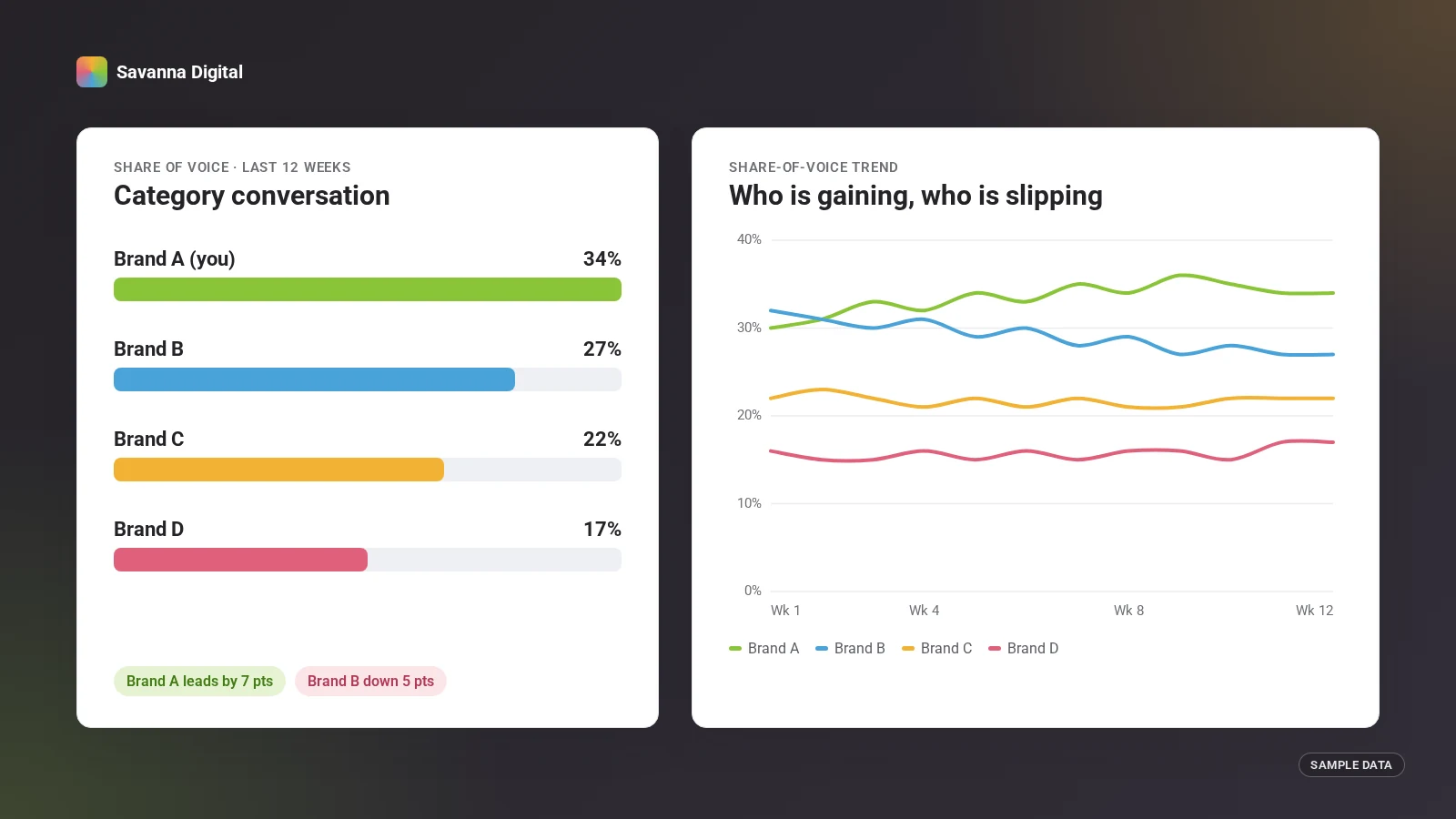
Most teams already know, in a general sense, whether a competitor is "louder" than them right now. Someone on the team saw a competitor's campaign trending, or noticed their name coming up more in client conversations. That kind of impression is useful, but it isn't a benchmark — it's a hunch, and hunches don't hold up when leadership asks for numbers. Competitor benchmarking is the practice of turning that impression into something you can actually measure: how much people are talking about a rival brand relative to you, how they feel about it, and whether that gap is widening or closing.
At its core, competitor benchmarking compares three things side by side: share of voice (how much of the total conversation in a category belongs to you versus a competitor), sentiment (whether the conversation about each brand is trending positive, negative, or neutral), and mention volume (the raw amount of conversation happening about each brand over time). None of these numbers mean much in isolation. A spike in your own mention volume looks like a win until you check whether a competitor spiked twice as hard in the same news cycle. Sentiment on its own doesn't tell you whether you're actually ahead — it tells you how people feel, not who's winning the larger conversation. Put together, updated continuously, they turn a gut feeling into a picture you can act on.
Manually benchmarking a competitor usually means someone on the team periodically Googling both brand names, skimming a handful of news sites, and eyeballing engagement on a few social posts. That's slow even in a single-language, single-platform market. As we've written about before, conversation across African markets moves across multiple platforms, local news outlets, blogs, and forums, and happens in English, Kiswahili, Sheng, and other African languages, often switching between them within the same thread. A manual check is likely to miss whatever's happening outside the handful of sources someone remembered to look at, and it has no way of tracking sentiment or volume consistently enough to compare over time. The gap between "we think we're doing better than Competitor X" and actually knowing it tends to be exactly the local coverage a manual check doesn't see.
A useful benchmarking setup tracks the same handful of things for every competitor you add: current share of voice, the sentiment split behind that share, the trend line over time rather than a single snapshot, and any sudden spikes that coincide with a specific launch, campaign, or news event. Historical comparison matters as much as the current number — a competitor with a smaller share of voice today but a steady upward trend is a different problem than one holding flat. This is also where the underlying monitoring matters: benchmarking is only as good as the mention data feeding it, which is why it works best paired with the same real-time, plain-language mention tracking used for your own brand.
The exact use case shifts by team, but the underlying need is the same: numbers instead of impressions. PR teams use it to show leadership where a brand stands relative to competitors after a campaign or news cycle, not just how much coverage they personally generated. Marketing teams use it to see how a campaign performed against the competitive backdrop it launched into, not in isolation. Agencies use it to give every client a comparative view for update calls, without building a one-off tracking spreadsheet per account. And market research teams use it as the historical, comparative layer on top of the topic and sentiment data they're already collecting.
Savanna Digital's competitor benchmarking feature compares your share of voice, sentiment, and mention volume directly against the competitors you choose to track, side by side, updated continuously — built on top of the same real-time monitoring and sentiment scoring that tracks your own brand, so the comparison is apples to apples rather than pulled from two different processes. When it's time to report on it, any view can be turned into a polished PDF, CSV, or PPTX in one click.
See how Savanna Digital's competitor benchmarking works in practice.
Explore Competitor BenchmarkingWant us to do this for you? See our SEO services.
Start tracking your brand's presence across the web and AI in minutes.
Start free — no credit card required.