What is Social Listening and Why It Matters for African Brands
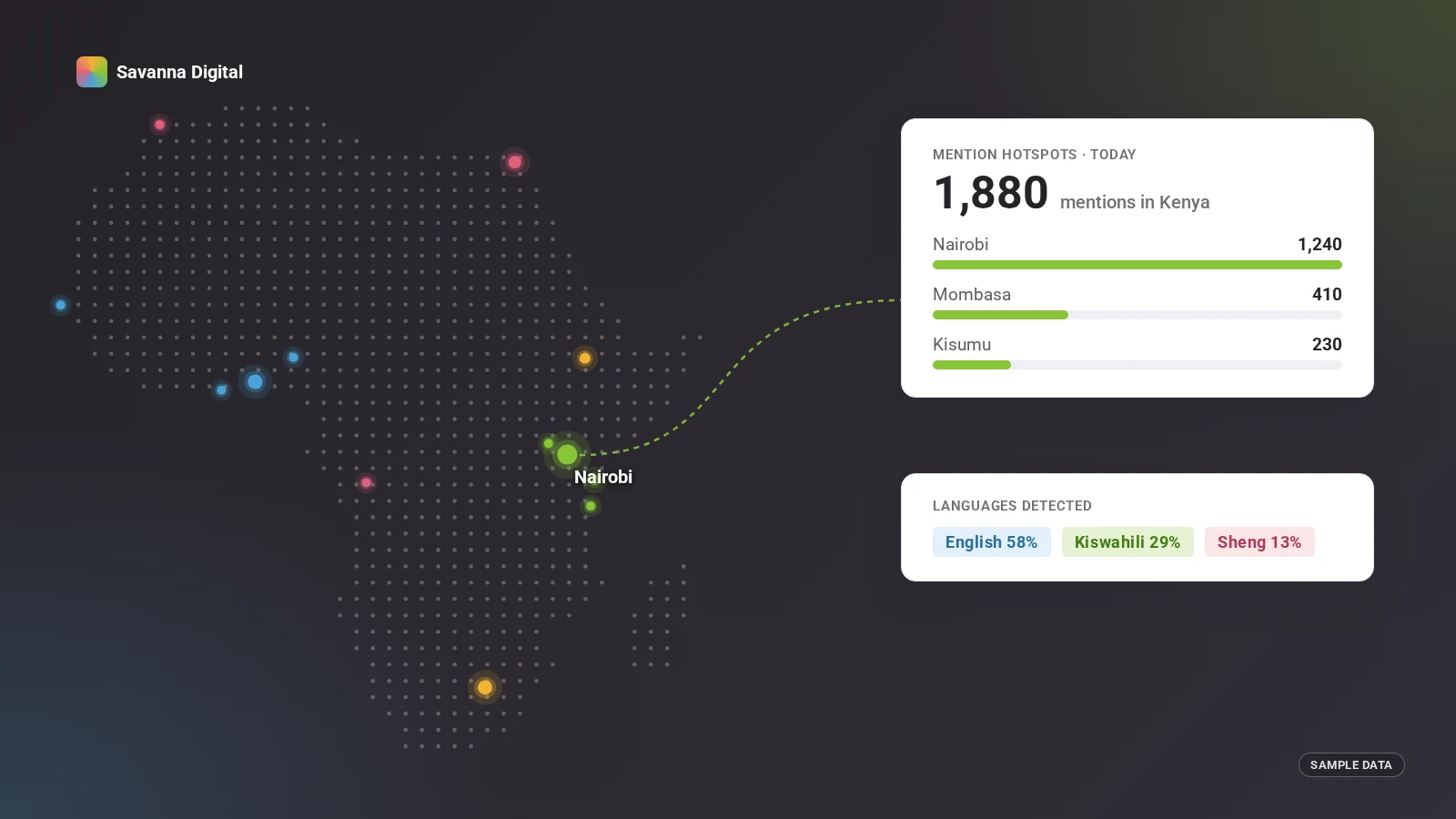
"Social listening" gets used loosely, often as a synonym for checking notifications or scrolling through mentions of a brand name. The actual practice is narrower and more useful than that. Social listening is the ongoing process of tracking conversations across public channels — social platforms, news sites, blogs, and forums — and turning that raw volume of chatter into something a team can act on: what people are saying, how they feel about it, and whether that's changing.
It helps to separate two related ideas. Monitoring is the act of collecting mentions: every post, article, or comment that references your brand, product, or a keyword you care about. Listening goes a step further. It groups those mentions into topics, scores them for sentiment, and surfaces the patterns a human would otherwise have to piece together by reading hundreds of posts one at a time. A monitoring feed tells you that mentions of your brand spiked. Listening tells you what that spike is actually about, and whether the sentiment attached to it is positive, negative, or mixed.
That distinction matters because the volume of public conversation is large and growing across nearly every category, from consumer goods to telecoms to public institutions. A team that only monitors ends up drowning in a feed. A team that listens can filter that feed down to what's actually worth their attention.
Most of the well-known social listening platforms were built for markets where conversation happens predominantly in one language, on a fairly narrow set of platforms, and within a media ecosystem that's already well indexed. Africa's information environment doesn't fit that mould as neatly. Conversations move across social platforms, local news outlets, blogs, and community forums, and they happen in English, Kiswahili, Sheng, and other African languages, often within the same thread or even the same sentence through code-switching.
A tool built primarily for English-language, single-market conversation can miss a meaningful share of what's actually being said, simply because it isn't tuned to recognize the language, slang, or local news sources where the conversation is happening. That's a real gap for any brand, agency, or public institution trying to understand its own reputation in the region — not because the volume of conversation is low, but because the tooling wasn't built to see all of it.
Used well, social listening changes the posture of a communications, marketing, or customer care team from reactive to proactive. Instead of finding out about a service complaint from a support ticket days later, a team sees the complaint as it's posted and can respond before it escalates. Instead of guessing how a campaign landed, a marketing team can see the sentiment and topic breakdown of the response as it happens, and feed that back into the next round of content. Instead of waiting for a quarterly report to know how a story is spreading, a PR team can watch coverage accumulate across news and social in a single feed, and can point to concrete share-of-voice and sentiment data when they need to demonstrate the impact of their work.
It's also useful for straightforward competitive awareness: how much are people talking about your competitors relative to you, and how does the tone of that conversation compare? None of this requires a data analyst on staff. Plain-language search, rather than Boolean query strings, means a team can start tracking a keyword or topic in minutes rather than spending a week configuring queries.
The simplest starting point is picking the handful of things that matter most right now — your brand name, your flagship product, maybe one or two competitors — and watching how they're discussed over a few weeks before expanding further. Sentiment and topic groupings will tell you where the real signal is; real-time alerts can catch the moments that need a fast response rather than a monthly review. Social listening isn't about collecting more data. It's about making the data that already exists about your brand legible enough to act on.
Social listening is one piece of a bigger discipline. See our fuller explainer on what media intelligence is and how it brings monitoring, listening, and analysis together.
See how Savanna Digital's monitoring and sentiment tools work in practice.
Explore Monitoring & Sentiment AnalysisWant us to do this for you? See our SEO services.
Start tracking your brand's presence across the web and AI in minutes.
Start free — no credit card required.