Media Monitoring for Lead Generation: Finding Prospects Before Your Competitors Do
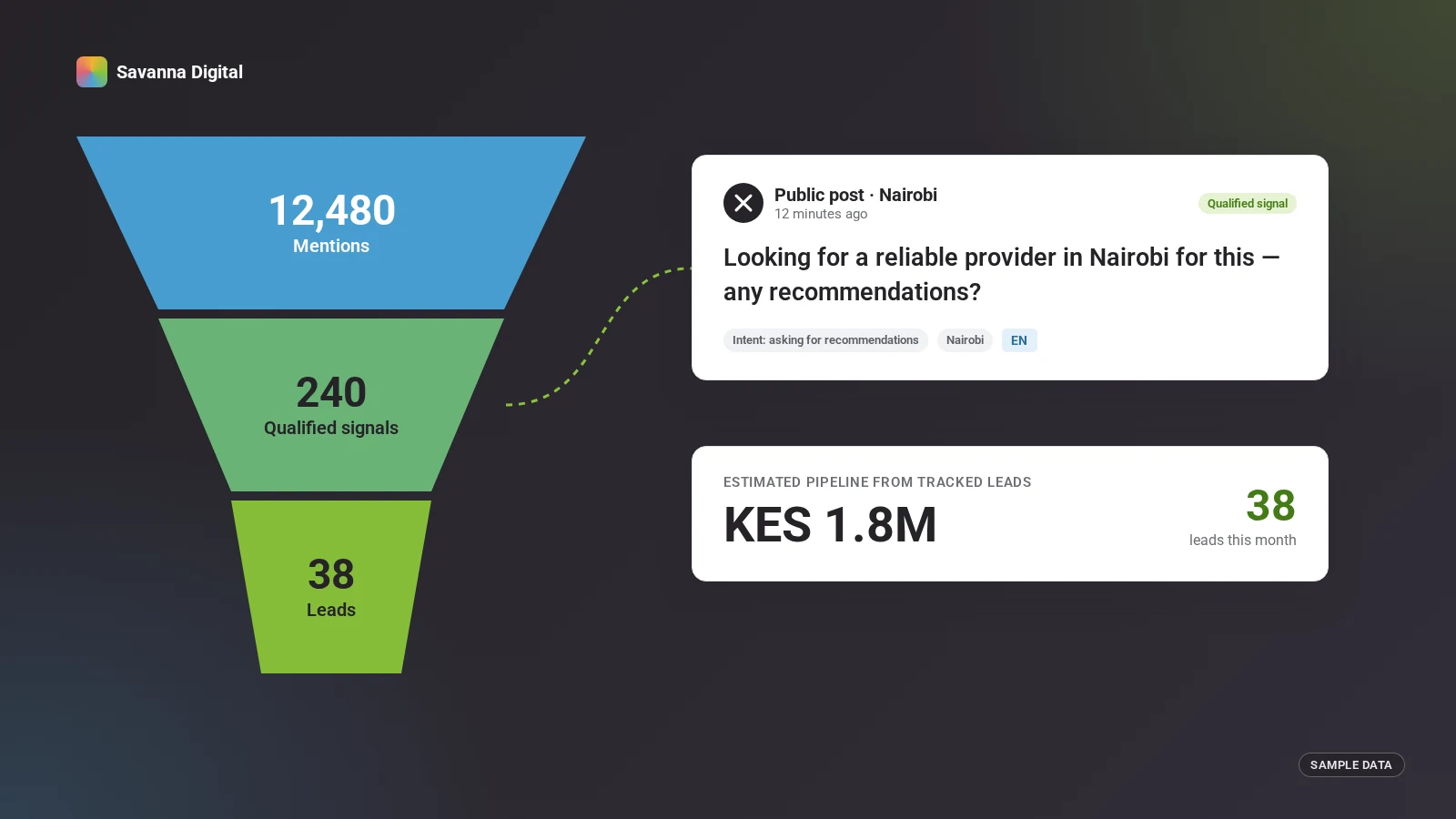
Most lead generation starts with outbound: a list, a cold email, a guess about who might need what you're selling. Media monitoring flips that. Instead of guessing who has a need, it surfaces people who've already said so, in public, often within the last few hours.
This is one of the most underused applications of media monitoring. Most teams that adopt it start with PR or customer care use cases and never extend it to sales — which leaves a genuinely warm channel of prospects sitting on the table.
Somewhere, right now, someone is publicly asking for a recommendation in your category. "Can anyone suggest a good [X] in Nairobi." "Anyone used [competitor] — is it worth it?" "Looking for a [service] that actually responds to support tickets." These posts show up on X, in Facebook groups, on forums, in the comments under a relevant article.
Two things make this different from a typical lead list:
A media monitoring platform with plain-language search means you don't need a data analyst to find these conversations — you type the query the way a person would actually ask it, the same way you'd search a normal search engine.
Read more on how plain-language search compares to Boolean monitoring tools.
Set up tracking for the phrases people actually use when they're in-market: "recommend a," "looking for a," "does anyone use," paired with your category. This surfaces prospects who've never heard of you yet — which is exactly the point.
People complaining about a competitor, or asking whether a competitor is worth switching to, are pre-qualified in a way a cold list never is. They already have the problem your product solves, and they're already unhappy with an alternative.
Before a first call or a proposal, pull up a prospect's media coverage over the past six to twelve months: what they've been in the press for, how their tone has shifted, whether they've had a recent launch or a rough patch. That context turns a generic pitch into one that references what's actually happening at the company — and it takes minutes, not a day of manual research.
Read more on how it works for Marketing Teams.
A lean way to run this without adding headcount: one saved search per category-intent phrase, one saved search per named competitor, and a real-time alert on both so new mentions land in Slack or email rather than requiring someone to check a dashboard. The team spends a few minutes a day reviewing new hits instead of hours prospecting cold.
See how Savanna Digital's alerting works in practice.
Explore Real-Time Alerts & Anomaly DetectionRelated but narrower. Social selling is the broader practice of using social platforms to build relationships and close deals. Monitoring for lead generation is the specific tactic of surfacing in-market prospects from public conversation, which then feeds a social-selling or outbound motion.
No, if your monitoring tool supports plain-language queries. Boolean strings can find the same conversations, but they take longer to build and are easier to get wrong — which is a real barrier for teams without a dedicated analyst.
Manual search only covers the platform you're searching, misses most local-language conversation, and doesn't alert you to new mentions in real time. A monitoring platform aggregates across news, social, and forums continuously and flags new hits as they happen.
Yes — arguably better, since a small team benefits most from not spending hours on manual prospecting. A handful of saved searches with alerts turned on does most of the work passively.
Want us to do this for you? See our SEO services.
Start tracking your brand's presence across the web and AI in minutes.
Start free — no credit card required.