How to Choose a Media Monitoring Tool: A Buyer's Guide
Most media monitoring tools look similar from the outside: a dashboard, a search bar, some charts. The differences that actually matter show up after you've committed — in whether the tool catches what your market is actually saying, and whether your team keeps using it after the first month.
Here's what's worth checking before you sign anything.
This is the question most buyers skip, and it's the one that determines whether you're seeing the full picture or a partial one. A tool built primarily for English-language, single-market conversation will undercount — sometimes badly — brands operating in multilingual markets.
If your audience discusses your brand in English, Kiswahili, Sheng, or switches between languages within the same post, ask specifically whether the platform is tuned to catch that, not just whether it technically supports "multiple languages." There's a real difference between a tool that translates keywords and one that's built to recognize how people in your market actually write.
Read more on why generic tools fall short in African markets.
Boolean search strings — combinations of AND, OR, NOT, and quotation marks — are the default query method for a lot of monitoring platforms. They work, but they're a real barrier: someone has to learn to build them well, and a poorly built query either misses relevant mentions or floods the dashboard with irrelevant ones.
Ask for a live demo of the search experience, not just a features list. If getting a useful result requires a trained query-builder, that's a cost you'll carry for as long as you use the tool.
A tool that requires someone to log in and check a dashboard will always be slower than one that tells your team when something changes. Ask specifically:
See Real-Time Alerts & Anomaly Detection
Traditional media monitoring covers news and social platforms. That's necessary but no longer sufficient. A growing share of people now ask AI chatbots — ChatGPT, Gemini, Claude, Perplexity — for recommendations and comparisons directly, and how your brand is described in those answers is becoming its own reputational surface.
Ask whether the platform tracks AI answer-engine visibility, and if not, whether that's on their roadmap. A tool that only watches the channels of five years ago is already behind.
Read more on why AI answer engines matter for brand monitoring now.
The best monitoring setup in the world doesn't help if the output can't be turned into something a PR director or a client can act on. Check whether the platform supports:
Read more on how it works for Agencies.
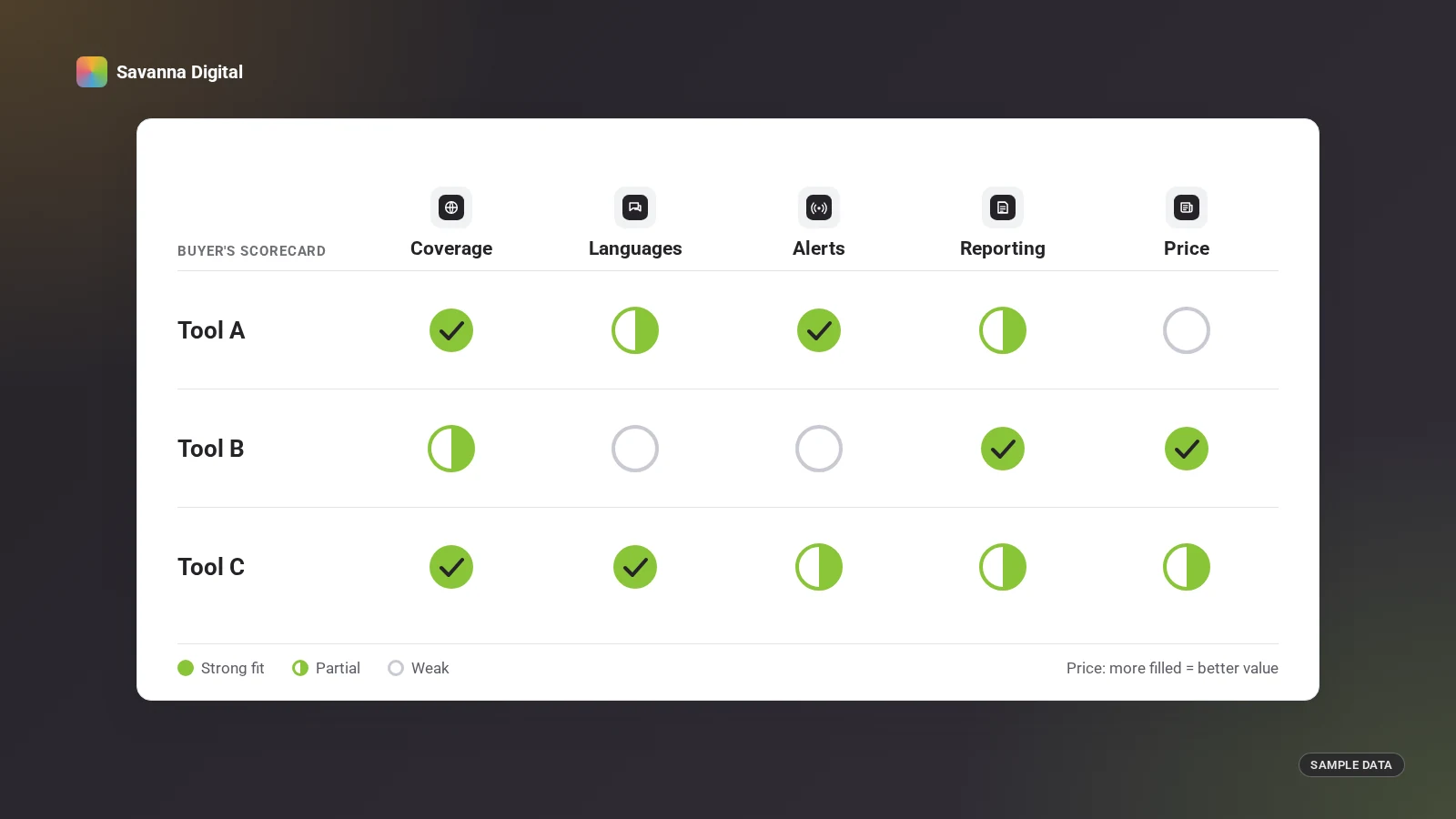
When you're evaluating more than one vendor, score each on the same five axes rather than getting pulled into a feature-by-feature bake-off:
| Question | Why it matters |
|---|---|
| Language & source coverage | Determines whether you're seeing the full conversation or a partial one |
| Ease of search | Determines how much of the tool your team actually uses day to day |
| Alerting quality | Determines how fast you find out about something that matters |
| Channel breadth | Determines whether you're covering where the conversation is actually moving, including AI |
| Reporting fit | Determines whether the output is usable by the people who need to see it |
See Savanna Digital's full suite in one place.
Explore the platformEvaluating tools primarily on feature count rather than on whether the tool actually catches the conversation in the languages and channels their market uses. A feature-rich tool that misses half the conversation is worse than a simpler one that catches all of it.
Not necessarily. Global vendors offer broad source coverage, but regional or market-specific vendors are often better tuned to local languages, code-switching, and local news sources — which matters more for accuracy than raw source count.
Long enough to run a real search on your own brand name and at least one competitor, and to see how the tool handles a mixed-language mention. A generic canned demo won't surface the gaps that matter.
Not necessarily — some platforms now include both in one suite, which avoids stitching together separate vendors and separate reporting.
Want us to do this for you? See our SEO services.
Start tracking your brand's presence across the web and AI in minutes.
Start free — no credit card required.