How to Catch a PR Crisis Before It Spreads: A Media Monitoring Playbook
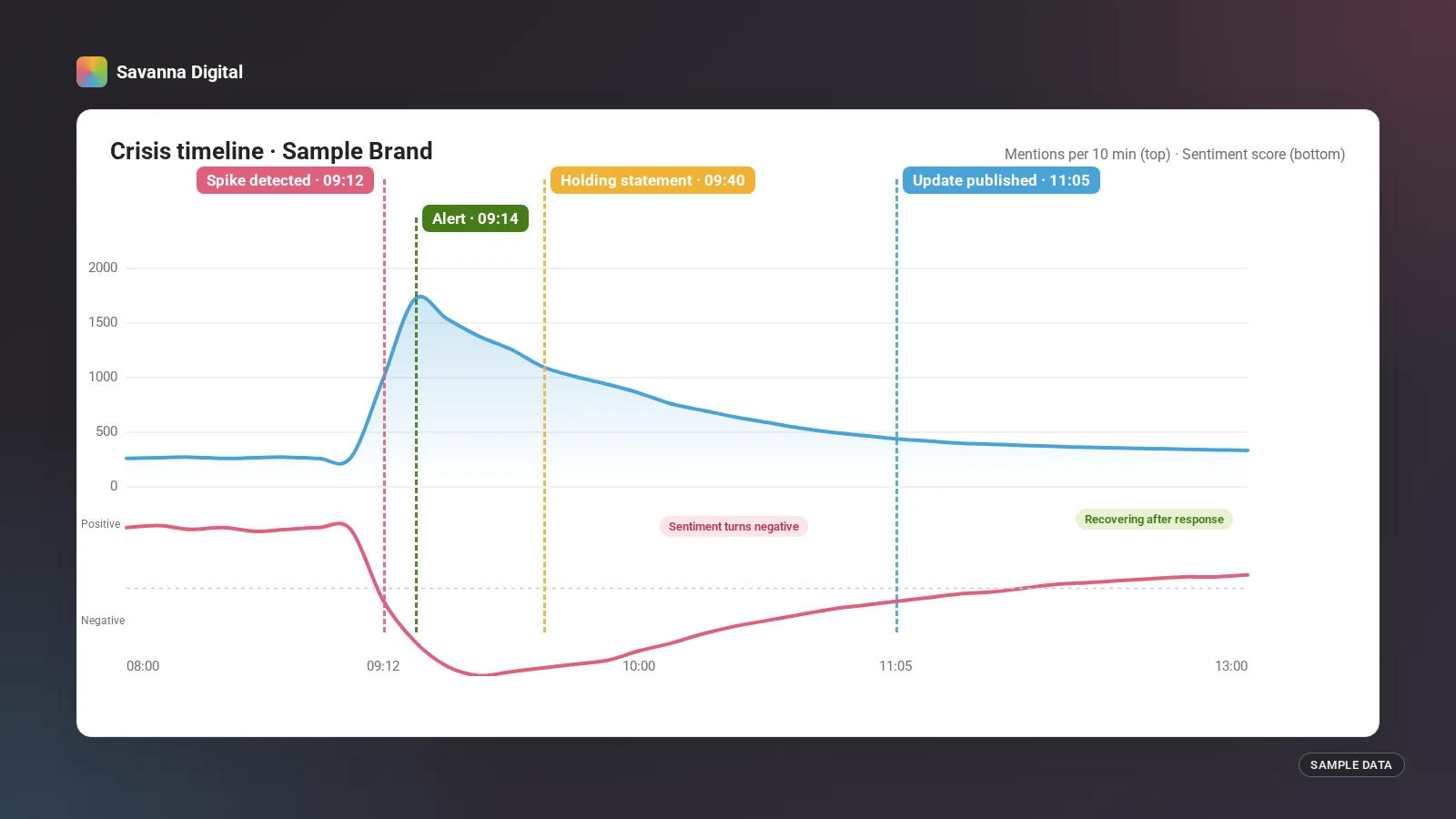
By the time a crisis is trending, it's already too late to catch it early. The window that actually matters is the hour or two before that — when a complaint, a video, or a bad customer interaction is still contained to a small number of posts, and a fast response can keep it there.
This is where media monitoring earns its keep for a PR team. Not as a reporting tool for what already happened, but as an early-warning system for what's about to.
Almost every brand crisis follows a similar shape: a single incident, a handful of posts, then — if nobody responds — a faster and faster accumulation as more people pile on, screenshot, and share. The incident itself is rarely preventable. What's preventable is how long it takes your team to notice.
A few early signals worth watching for:
Read more on why sentiment and topic grouping matter more than raw mention counts.
A keyword alert tells you every time your brand is mentioned — which, at any real volume, becomes noise a team stops reading. An anomaly alert tells you when mention volume or sentiment moves outside its normal range, which is the actual signal worth interrupting someone's day for.
An alert that lands in an inbox nobody checks in real time isn't a real-time system. Alerts should land in Slack, email, or wherever your PR and comms team is already working, so the gap between "something happened" and "someone saw it" is minutes, not hours.
Explore Real-Time Alerts & Anomaly Detection
A crisis at a competitor is useful information even when it's not about you — it tells you what kind of incident is resonating in your market right now, and it's a preview of the kind of scrutiny your own brand could face under similar circumstances.
When an alert fires, the first hour matters more than the first day:
Read more on how it works for PR Teams.
Conversation in African markets moves across news, social, and forums in multiple languages, often faster than a single-language monitoring tool can track. A story that starts in Kiswahili or Sheng on a local platform can reach mainstream coverage before an English-only monitoring setup even registers it. Coverage that spans the languages your market actually speaks isn't a nice-to-have here — it's the difference between an early warning and finding out from a headline.
See how Savanna Digital's monitoring and sentiment tools work in practice.
Explore Monitoring & Sentiment AnalysisIt depends on the incident, but anomaly-based alerting typically flags unusual activity within minutes of a spike starting, well before a story would reach mainstream news coverage.
A keyword alert fires on every mention of a term. An anomaly alert fires only when volume or sentiment moves meaningfully outside its normal pattern — which filters out routine mentions and surfaces the ones that actually need attention.
Yes. A competitor's crisis often previews the kind of scrutiny your own brand could face, and it gives your team a real example to stress-test your own response plan against.
No — it's the detection layer that tells you when to activate one. The response checklist, sign-off chain, and messaging still need to be planned in advance; monitoring just shortens the time between "something happened" and "the right people know."
Want us to do this for you? See our SEO services.
Start tracking your brand's presence across the web and AI in minutes.
Start free — no credit card required.