What Is Media Intelligence? Definition, Components, and Use Cases
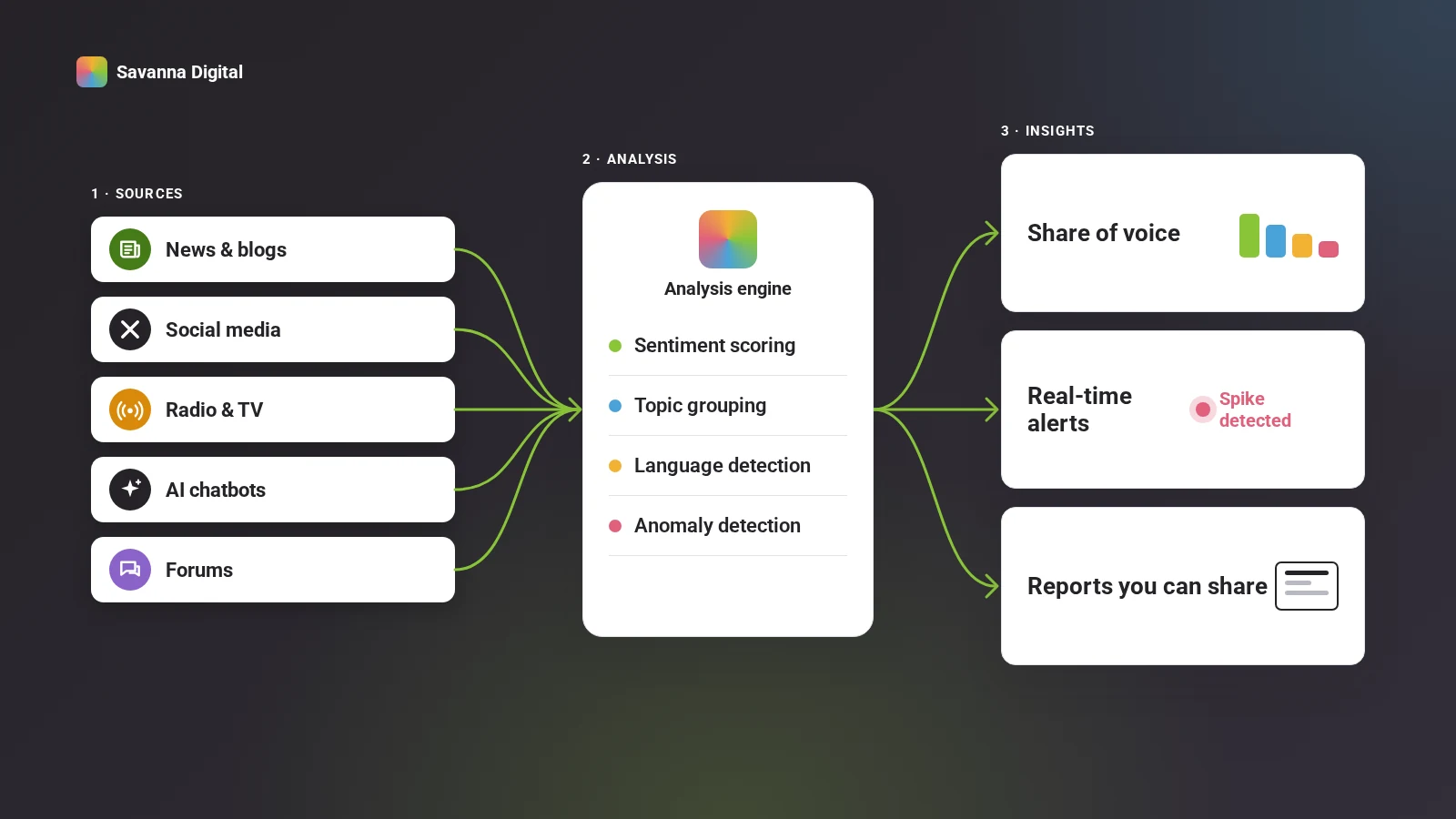
People are talking about your brand right now — on news sites, on X and TikTok, in WhatsApp-adjacent forums, in the comments under a blogger's post. Most of that conversation happens whether or not anyone on your team is watching. Media intelligence is the discipline of watching it anyway, and turning what you find into decisions.
It's a term that gets used loosely, often as a stand-in for "checking mentions." The actual practice is broader than that, and understanding the full shape of it is what separates a team that reacts to headlines from one that sees them coming.
Media intelligence is the umbrella term for three connected activities:
None of the three is optional. Monitoring without analysis is just a bigger inbox. Analysis without monitoring has nothing to analyze. Media intelligence is what you get when all three run together, continuously, across every channel where your brand's reputation is actually being formed.
Read more on the difference between monitoring and listening.
Most write-ups of media intelligence assume a media environment that's already well indexed, in one dominant language, on a fairly narrow set of platforms. That's not the environment African brands operate in. Conversation about a brand in Nairobi, Lagos, or Accra moves across news outlets, social platforms, and community forums, in English, Kiswahili, Sheng, and other local languages — often switching between them mid-sentence.
A media intelligence approach built for a single-language, single-market conversation misses a real share of what's actually being said about your brand. Not because the conversation is quiet, but because the tooling isn't tuned to see all of it. That's the gap Savanna Digital is built to close: plain-language search instead of Boolean strings, and coverage tuned to how people in African markets actually write and speak.
Media intelligence isn't only about watching your own name. Benchmarking your brand against competitors — tone, volume, and the themes driving each — surfaces threats and openings you won't see by looking inward. If a competitor has a rough week, that's useful context. If they don't, that's useful too.
Metrics worth tracking here:
Explore Competitor Benchmarking
Media intelligence isn't only a defensive tool. Searching for the conversations where people are actively asking for a recommendation in your category — or complaining about a competitor — surfaces prospects who've already told you they have a need. That's a warmer lead than most outbound lists will ever produce.
Complaints and service issues usually show up in public conversation before they hit a support ticket. Real-time alerts on unusual spikes in mention volume or negative sentiment let a customer care team respond to a problem while it's still small, rather than finding out about it from an escalation.
Read more on how it works for Customer Care.
The same alerting that helps customer care catches a reputational problem before it becomes a headline. Watching sentiment and volume in real time — rather than reviewing coverage after the fact — is the difference between managing a story and reacting to one that's already spread.
A few questions worth answering before you commit to a vendor:
Read more on why AI answer engines are part of this conversation now.
Media intelligence works best as one continuous discipline rather than three separate tools bolted together. A single source of truth for monitoring, sentiment, and reporting means your PR, marketing, and customer care teams are working from the same numbers — which matters as much for a team of five as it does for a multinational.
See Savanna Digital's full suite in one place.
Explore the platformNo. Social listening is one component of media intelligence. Media intelligence also includes monitoring of traditional and broadcast media, plus the data analysis layer that turns raw mentions into trends.
Monitoring is collection — every mention, gathered in one place. Intelligence is what you get once that collection is grouped by topic, scored for sentiment, and turned into something a team can act on.
Not with a plain-language tool. Platforms that require Boolean search strings do effectively require analyst-level query-building; platforms built around natural-language search don't.
Coverage needs to account for multiple local languages (Kiswahili, Sheng, and others), local news sources, and code-switching within a single post or thread — none of which most globally-built tools are tuned to catch.
Increasingly, yes. How a brand is described when someone asks an AI assistant about it is becoming a reputational surface in its own right, alongside news and social.
Want us to do this for you? See our SEO services.
Start tracking your brand's presence across the web and AI in minutes.
Start free — no credit card required.